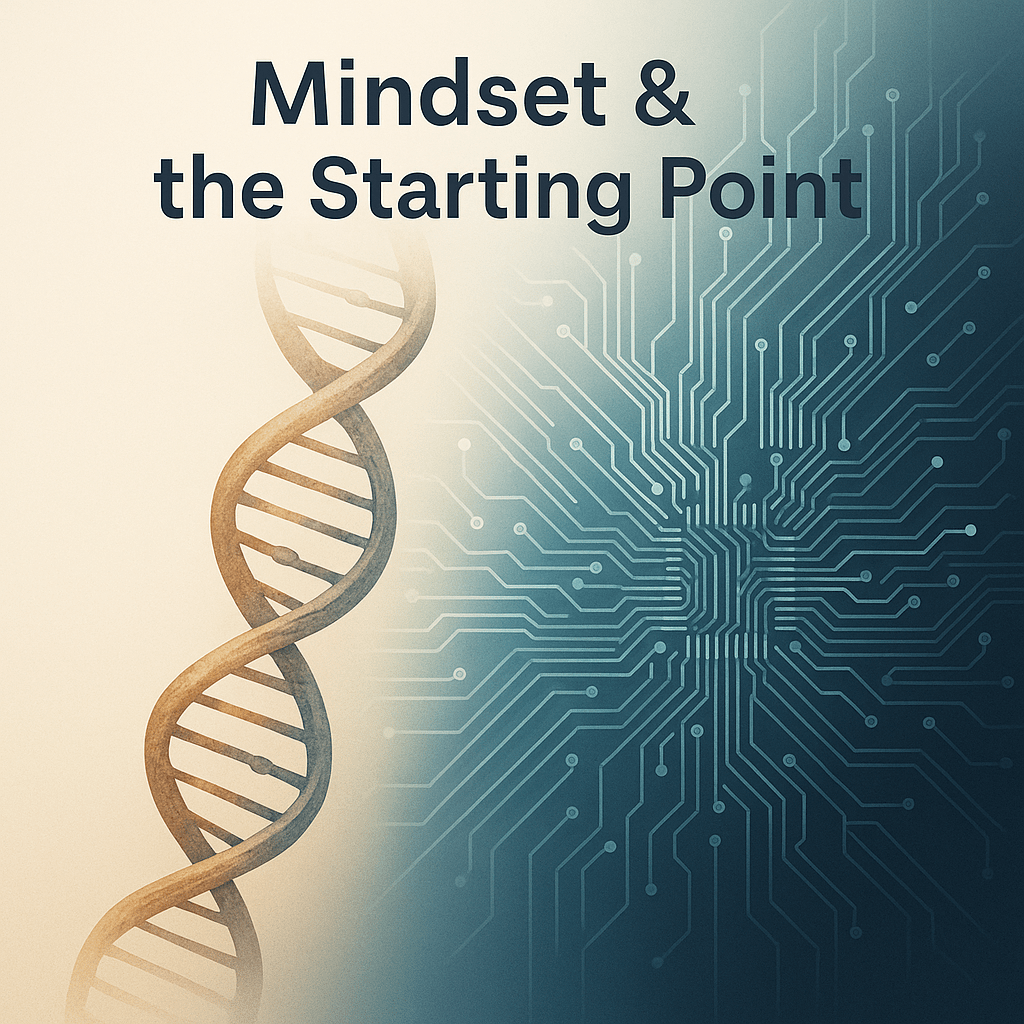
Reading Dr. Ram Charan’s recent article on The Mindset Behind Trillion-Dollar Companies reminded me of a post I wrote two years back, in April 2023 — about how a company’s mindset and starting point shape its organizational DNA.
He speaks of building data systems that learn and compound — a theme that closely aligns with what I had described as the shift from data centricity to data at scale. Both perspectives emphasize that advantage doesn’t lie in having data, but in how it’s connected, reused, and embedded into decision-making loops across the organization.
He also points out that legacy companies start with hardware and add software later, while digital-first companies begin with the customer and build software-defined architectures around their needs. In essence, it’s the same distinction I drew between offline and online starting points — where the initial design logic shapes not just technology, but culture, speed, and learning.
He also speaks of the law of increasing returns — where data compounds and marginal costs approach zero. In many ways, that mirrors my view on the shift from fixed-cost structures to variable ones — organizations moving away from asset-heavy models toward architectures that flex, scale, and learn.
My reflection began upstream: the initial DNA defines the range of strategic choices a company can make — shaping not just what it does, but what it can imagine doing. How an organization’s mindset, structure, and data at scale define its agility, risk appetite, and eventual scale. If you create the DNA of a dwarf, it’s hard to grow into a giant later — even with capital and opportunity.
He speaks of the fruits; I examined the roots. Two perspectives on the same question: what determines how companies learn, adapt, and compound advantage in an accelerating world?
After revisiting that post, I had the opportunity to attend a panel session featuring the CEOs of Revolut India, Razorpay, and Monzo Bank. Interestingly, this same question of the starting point resurfaced there.
The debate was simple yet revealing: Can a traditional bank truly become a tech-led company, or can a tech company become a good bank? The same paradox plays out across industries — legacy institutions trying to code speed and data into their DNA, while digital natives struggle to build the trust and governance that come naturally to incumbents. Different starting points, different constraints — and different paths to scale.
How often does our starting point shape our journey and decisions — whether in the life of an organization or our own? Very often, because we tend to view the world through that very prism.
That lens influences not only our choices but the very architecture of how we operate — in teams, in companies, in strategy itself.
What we sometimes forget is that the starting point doesn’t just shape what we build, but how we think and design organizations.Yet the question isn’t whether starting points matter — they clearly do — but how profoundly they constrain or empower the strategic choices of leadership.
While I used online and offline as two extremes in my 2023 post, the reality is that neither path guarantees success — especially as the two models continue to converge. It’s about the building blocks — mindset, data centricity, how you view and leverage cost structures, growth orientation, willingness to assess risk, and, of course, the ability to attract talent. These elements, baked in early, shape what becomes possible later. But they can be rebuilt — it’s just exponentially harder.
Online vs Offline – Is the Difference in the DNA?
The Starting Point
I was a speaker at a forum when someone asked me —
If we are moving from offline to online and the online players to offline, then what’s really the difference?
He was, of course, referring to the difference in valuation.
The moot question is — as we move towards a more omnichannel approach, does our starting point really matter, especially if both roads will eventually converge?
When I look at the basic approach of these two different starting points — online and offline — certain key differences emerge.
1. Agility
The speed and agility in responding to markets and consumers.
While offline companies are more calibrated in their response, online companies respond significantly faster and are better positioned to take advantage of emerging opportunities.
(Deliberate Strategy vs. Emergent Strategy)
2. Data – Data Centricity vs. Data at Scale
Offline companies have made significant progress but are largely data centric, often limited to departments such as merchandising.
Digital companies, by contrast, use data at scale — interconnected across functions, creating continuous intelligence loops.
3. Risk Willingness and Ability to Assess Risk
Offline companies generally approach risk incrementally.
Online companies evaluate risk more transformationally, through alternate outcome frameworks.
(I have consciously used “willingness and ability to take risk” vs. “actual risk taken.”)
4. Fixed vs. Variable Cost Mindset
Offline companies operate with a more fixed-cost structure — large upfront investments in stores, interiors, and marketing — with longer feedback cycles and defined thresholds to recalibrate.
Online companies, by contrast, use variable cost structures, where costs scale with growth.
They rely on SaaS models, digital testing, and micro-segmentation to stay flexible and data-driven.
5. Talent
Online companies tend to attract stronger, more diverse talent.
Offline firms often prioritize experience within their own industry, while digital-first organizations are flatter, data-integrated, and offer higher visibility and ownership (through ESOPs and cross-functional accountability).
Closing Reflection
The consumer journey is no longer linear.
Both online and offline companies are moving towards omnichannel convergence — yet, given their fundamentally different DNAs, their outcomes will likely remain distinct.
On a parting note, something to think about:
- If an offline business decides to grow online, how much can it achieve over three years — 10%, 20%, 30%?
- Conversely, if an online business expands offline, could it reach 30%, 40%, or even 50%?
Originally Published
Originally shared on LinkedIn, April 2, 2023
View Original Post →
About the Author : Vijay Jain
Vijay Jain is a seasoned consumer and retail expert with over 25 years’ experience in building and scaling businesses. As Founder-Director of ORRA and former CEO of ORRA and Ritu Kumar, he has led both founder-driven and professionally managed companies, delivering growth, cultural transformation, and customer-centricity. He brings a rare blend of financial acumen from investment banking and operating expertise as CEO. Today, as an Operating Partner, Advisory Board Member, and Board Mentor, he works across industries — from consumer to emerging tech — with a focus on governance, strategy, and sustainable growth. Deeply engaged with AI and digital transformation, Vijay helps businesses leverage technology, strategy, and people to scale faster and build future-ready organisations. He is also a recognized speaker, having shared insights on leadership, scaling brands, and digital transformation at platforms including CII, Harvard Business School, and Google.
 👉 Vijay Jain – Thoughts, Notes & Frameworks
Leave a comment